

Hunger Action Month is a time to come together, raise awareness, and remind our communities that it takes a village to help solve food insecurity.
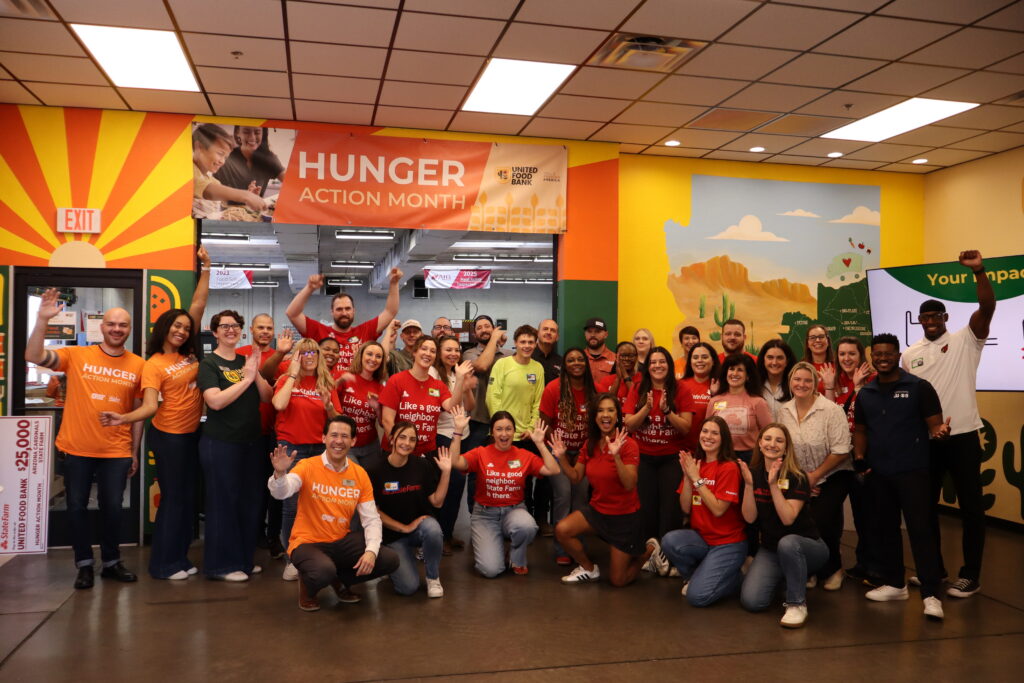
Throughout the month, the United Food Bank community showed up in different ways. All month long, our staff wore bright orange to stand in solidarity with food banks and communities across the Feeding America network. Families also gathered for Family Action Day, a day of volunteerism, and gave children an opportunity to learn about food insecurity.
This year, we wanted to extend Hunger Action Month. On October 1, we hosted our second annual Hunger Action Month Telethon. In partnership with Channel 3’s Your Life Arizona channel, this one-hour special brought together staff, volunteers and community supporters, including Big Red from the Arizona Cardinals, to share stories and raise awareness about food insecurity across the state. By celebrating Hunger Action Month one extra day, we wanted to remind viewers that food insecurity is a year-round problem, it doesn’t end when September does.
But what inspires someone to take action?
At United Food Bank, we wanted to explore this question further. This Hunger Action Month, we asked several members of the United Food Bank community to share their “why” and what taking action means to them. We wanted to hear the experiences and motivations that inspire them to show up for their neighbors.
Trish Jenning’s story with United Food Bank began during COVID-19, following the loss of a loved one. As she navigated her grief, she knew she needed something to help her move forward.
“I needed something to give me purpose,” she remarked.
She found that purpose through volunteering and giving back to her local community. Years later, Jennings has become a volunteer leader at United Food Bank. As a volunteer leader, she serves neighbors at Neighbor’s Pantry distributions multiple times a week, stacking cans during food bag builds, and lending a hand at mobile distributions. The work can be physically demanding, but for her, the reward goes far beyond the work itself. Volunteering has given her a sense of purpose, a connection to her community and the opportunity to make a difference in the lives of others.
For Rick Warren, his “why” for getting involved with United Food Bank and his passion for fighting food insecurity are deeply personal.
Raised by a single mother, Warren himself has experienced food insecurity firsthand. As the youngest of five siblings, he saw firsthand the sacrifices his mother made to provide for him and his siblings. Oftentimes, it was challenging to put food on the table. However, it was the support of the Mesa community and food assistance programs, such as church food pantries, that enabled his mother to ensure all her kids had enough to eat.
Now, as an adult, Warren is in a better position, but he has never forgotten where he came from. Now serving as the Board Chair, Warren continues to make a difference for neighbors facing food insecurity. For him, taking Hunger Action means recognizing that hunger may be affecting people around us, even when we don’t see it.
“I think if you don’t live it personally or are exposed to it, it’s easy to not realize it’s a problem.”
His experience is a reminder that food insecurity does not always look the way we expect.
As someone who was born and raised in the Arizona community, Josette Raper’s connection to United Food Bank’s mission is deeply personal. Years ago, her grandparents relied on a food bank for assistance when they were struggling to put food on the table. Without the support they received, Raper says, her family’s story, and ultimately her own, could have looked very different.
“My why is the people and the community. I’m passionate about making sure that our neighbors have access to the food and resources they need.”
That passion led her to United Food Bank, where she serves as the Agency Network Manager, helping support the network of partner agencies that connect neighbors with food and resources.
Over the past three years working at United Food Bank, Raper has heard hundreds of stories from neighbors about why they seek assistance. But one moment that has stayed with her happened during a holiday distribution, when she was registering a mother with several children in the back seat of her car.
She knows firsthand that a helping hand can make a lasting difference. Her grandparents once relied on a food bank, and now she is part of the team helping provide that same lifeline to families across Arizona. For her, taking hunger action is about giving back to the community that helped her family and making sure no neighbor has to face a difficult season alone.
Why do people take action to fight hunger?
The answer is different for everyone. It may come from personal experience, a chance to meet new people or simply a belief that everyone deserves access to the food they need. That is what Hunger Action Month is all about: recognizing that there is no single way to take action. Whether it’s volunteering your time, donating or speaking up about food insecurity, every action starts with a “why.” While each “why” may be different, together they bring people closer and help create stronger communities where no one has to face hunger alone.
Communications Specialist
ifleck@unitedfoodbank.org