For most people, when your fridge runs low on food, the solution is simple: get in the car and drive a few minutes to the nearest grocery store. But for families in rural and tribal communities, that same usual grocery trip can take an hour or more one way, if they have access to reliable transportation.
Food insecurity affects every county in Arizona, even in the wealthiest areas of our state. But what is often overlooked, however, food insecurity is often seen as a significant concern in Arizona’s rural and tribal communities, such as Gila, Navajo and Apache counties. Often referred to as ‘food deserts,’ these communities with limited access to affordable, nutritious food.
According to the Arizona Food Bank Network, 1 in 4 Indigenous Arizonans experience food insecurity, nearly double the state average of 1 in 7. In Gila County alone, food insecurity rates are significant, where about 17.3% of residents are documented as food insecure, underscoring the challenges these communities face daily.
As the landscape of food assistance continues to shift and food pantries see increased need, more of these food deserts are trying to keep up. A combination of factors contributes to this growing issue, including families losing their SNAP benefits and grocery costs that are often higher than those in urban areas. These challenges are further compounded by geographic isolation, limiting access to essential resources, including grocery stores, which are often scarce and spread out. For example, on the largest reservation in the country, the Navajo Nation, just 13 grocery stores serve the entire area. This often leaves families traveling long distances, sometimes over an hour one way, to access the necessities, like food.
In tribal communities like San Carlos, food insecurity is not an abstract issue, but something reflected in the daily realities of local households. On the reservations, households extend well beyond the traditional family unit, often numbering 18 to 20 family members, including parents, grandparents, and children, all under one roof. This makes it much more challenging to afford and access healthy foods for the whole family.
Food should be accessible to everyone, regardless of zip code. Yet for many Arizonans, having access to nutrient-rich meals and fresh produce is often seen as a luxury. It shouldn’t be this way. To assist in these efforts, United Food Bank’s newly launched mobile distribution program has become an essential lifeline for these communities.
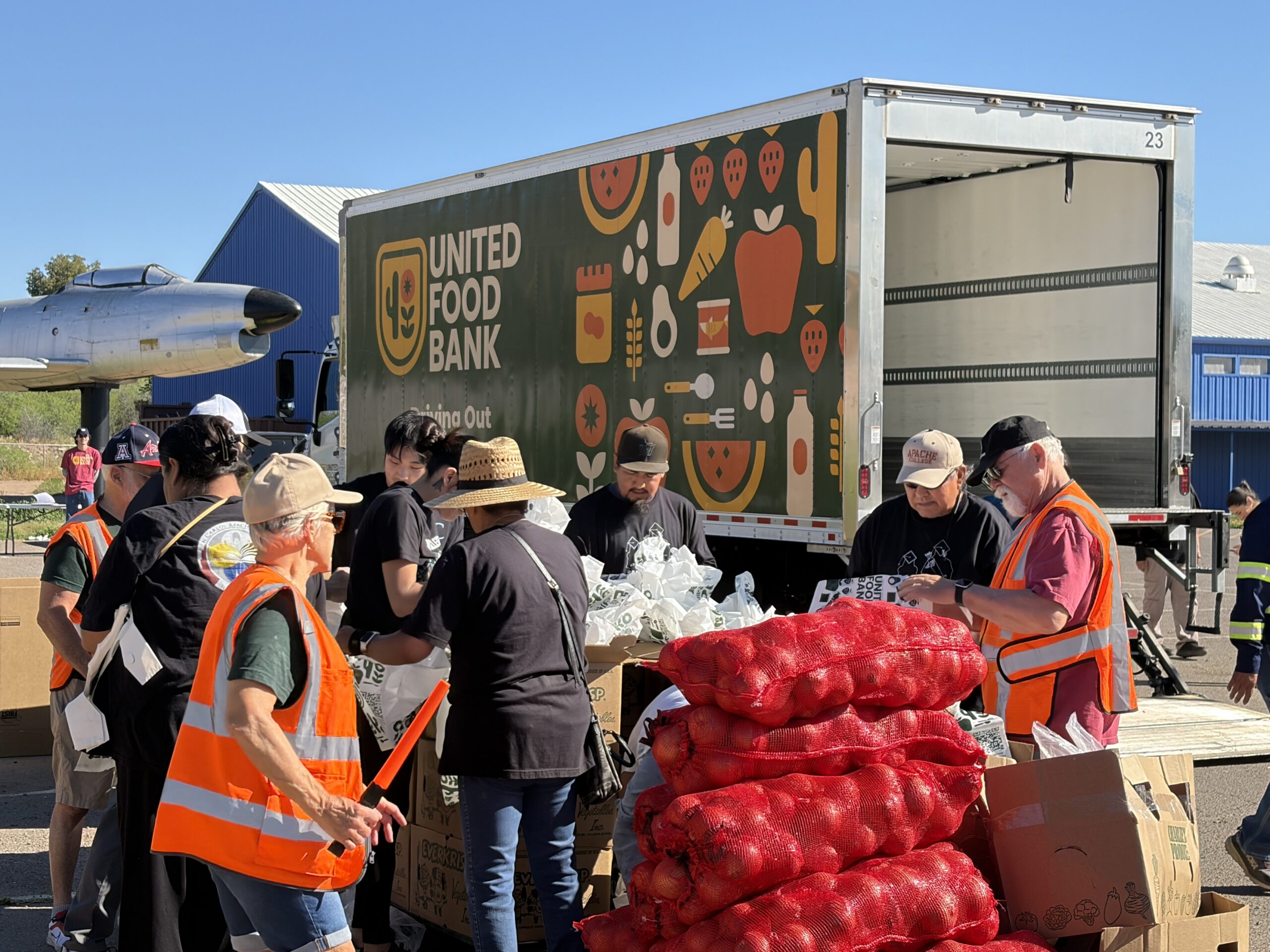
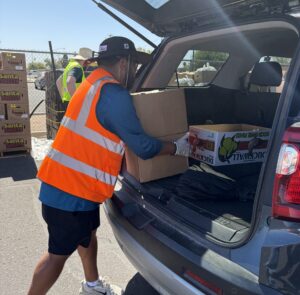
Mobile distributions are designed to function like a pop-up food pantry on wheels. Instead of asking families to travel long distances to the nearest food pantry, mobile distributions bring a large truck stocked with fresh produce, shelf-stable items and other food essentials directly to the heart of the community. On distribution day, one of United Food Bank’s semi-trucks arrives at a large parking lot, where volunteers and staff help unload the food, set up rows of food stations and organize the line of cars. As vehicles move slowly through the line, volunteers open each car’s trunk and place boxes of food directly inside.
At the end of 2025, during the government shutdown, households had their SNAP benefits temporarily halted. Families came to us and our partner agencies in droves, making it challenging to keep up with the demand. In response, United Food Bank introduced the new mobile distribution programs in Florence and Show Low to help meet the needs of those rural communities during this critical time. What began as a short-term response quickly revealed a long-term need.
Today, that need continues to grow. As of May 2026, United Food Bank now hosts four monthly mobile distributions, serving the communities of San Manuel, San Carlos, Show Low and Casa Grande. At each distribution, we prepare to serve about 250 households, and we reach that number very quickly each time.
For David Gonzalez, United Food Bank’s Mobile Distribution Coordinator, this is just the beginning. With plans to expand the program to reach more areas across United Food Bank’s service area, Gonzalez shares that this ongoing growth reflects the challenges and the needs of the community.
“It only shows that the need is only growing, especially nowadays, with the price of living as a whole skyrocketing,” shared Gonzalez. “And just the overall quality of life is getting more expensive day by day.”
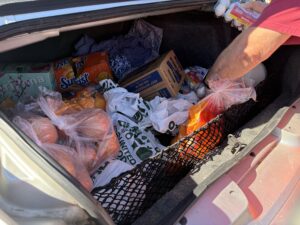
These monthly mobile food distributions provide more than a convenience—it’s one of the few opportunities to bring home fresh fruits and vegetables. While this program is still relatively new, it has already made a tremendous impact in San Carlos. Bill Astor, a community member and board member of the Nalwoodi Denzhone Community partner agency, has personally witnessed the joy these distributions bring to families. Not only does it allow people to have consistent access to fresh fruits and vegetables, but it also provides parents with hope and comfort knowing that their children will be well-fed.
“It gives the parents a great sense of joy and pride when they take these boxes home. And they prepare their meals for their children,” shared Astor. “We make this world by feeding our people and not having them survive, but having them thrive, and feeding them with hope.”
As United Food Bank continues expanding its mobile distribution program to reach additional rural communities in Arizona, the mission remains clear: no family should have to go without nutritious food simply because of where they live. By bringing food directly to rural and tribal communities, these distributions help close the gap between food and families, one truckload at a time.
If you are interested in making a difference and being part of these mobile distributions, keep an eye out for available volunteer opportunities.

Communications Specialist
ifleck@unitedfoodbank.org